
How Digital Wallets Are Changing Everyday Transactions: The Future of Frictionless Finance

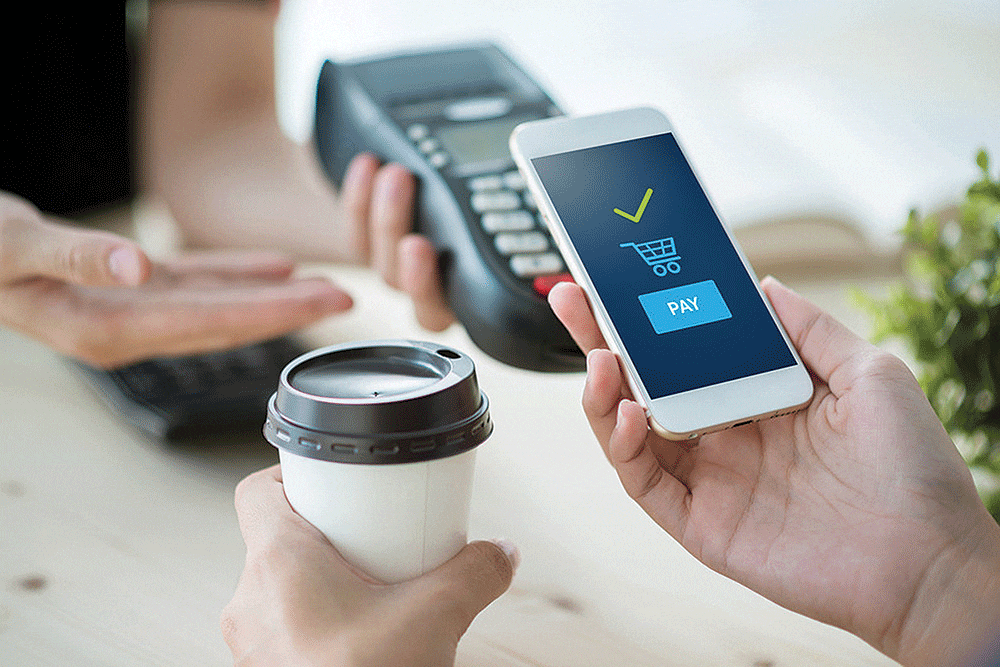
The leather wallet, once a thick repository of plastic cards, paper receipts, and loose change, is becoming a relic of the past. In its place, the smartphone has emerged as the command center for personal finance. Digital wallets—software-based systems that securely store users' payment information and passwords—are no longer just a "cool alternative" for tech enthusiasts. They have fundamentally rewritten the script of our daily economic interactions.
From the morning coffee run to cross-border business payments, digital wallets like Apple Pay, Google Wallet, and regional giants like WeChat Pay or Pix are streamlining how we move value. This shift is driven by a trifecta of convenience, enhanced security, and the integration of diverse financial services into a single interface.
The Evolution of the "Tap and Go" Culture
The most visible change is the speed of physical transactions. Near Field Communication (NFC) technology allows users to pay by simply hovering their device over a terminal. This "frictionless" experience does more than just save seconds at the checkout counter; it changes consumer psychology.
When the barrier to payment is lowered, the transaction becomes an afterthought to the experience. For retailers, this means shorter queues and higher throughput. For consumers, it means never having to worry about leaving a physical wallet at home. The integration of digital wallets into wearables, such as smartwatches, has further untethered us from physical currency, making "payment" a gesture rather than a process.
Security in the Age of Data Breaches
A common misconception is that digital wallets are less secure than physical cards because phones can be hacked. In reality, digital wallets often provide superior protection through tokenization and biometric authentication.
- Tokenization: When you pay with a digital wallet, your actual credit card number is never shared with the merchant. Instead, the system generates a "token"—a random string of numbers—to represent the transaction. Even if a merchant's database is breached, the hackers find no usable financial data.
- Biometrics: Modern wallets require a fingerprint, facial recognition, or a PIN to authorize a transaction. If you lose your physical wallet, anyone can swipe your cards until you cancel them. If you lose your phone, your financial data remains locked behind layers of encryption and biometric security.
Beyond Payments: The All-in-One Digital Hub
Perhaps the most significant way digital wallets are changing our lives is by evolving into "super-apps." They are no longer just for credit cards; they are becoming digital containers for our entire lives.
- Digital Identity: Many jurisdictions now allow citizens to store digital driver's licenses and national ID cards within their wallets.
- Ticketing and Transit: From boarding passes to concert tickets and subway fares, the digital wallet acts as a universal key. In cities like London or New York, the "contactless" revolution has virtually eliminated the need for proprietary transit cards.
- Loyalty and Rewards: One of the biggest pain points for consumers is managing dozens of loyalty programs. Digital wallets automatically apply coupons and track reward points at the point of sale, ensuring that users never miss out on savings.
The Democratization of Financial Services
In many parts of the developing world, digital wallets have skipped the "credit card phase" entirely, moving populations directly from cash to mobile commerce. This has led to unprecedented levels of financial inclusion.
In regions where traditional banking infrastructure is sparse, a digital wallet requires only a mobile signal. This allows unbanked individuals to receive wages, pay bills, and save money securely. The rise of peer-to-peer (P2P) transfers has also revolutionized the informal economy, allowing small-scale vendors to accept digital payments without expensive Point of Sale (PoS) hardware.
The Integration of Blockchain and CBDCs
As we look toward the future, the next frontier for digital wallets is the integration of Central Bank Digital Currencies (CBDCs) and stablecoins.
Traditional digital wallets still rely on the underlying banking system to settle transactions, which can take days for international transfers. By incorporating blockchain technology, digital wallets can facilitate near-instantaneous global payments with minimal fees. This blurs the line between traditional "fiat" money and digital assets, allowing users to hold various forms of value in a single location and swap between them seamlessly.
As the number of intermediary banks (nodes) decreases through direct digital wallet-to-wallet transfers, the speed and efficiency of the global economy increase exponentially.
Challenges: Privacy and the "Digital Divide"
Despite the benefits, the transition is not without hurdles. The primary concern for many is privacy. As every transaction is digitized, a massive trail of data is created. Who owns this data—the tech company, the bank, or the user? Balancing the convenience of personalized offers with the right to financial anonymity remains a heated debate.
Furthermore, there is the risk of the "digital divide." As businesses move toward "cashless only" models, those without smartphones or reliable internet access—often the elderly or the impoverished—risk being marginalized. For digital wallets to truly revolutionize everyday life for everyone, the transition must be inclusive, ensuring that physical cash remains a viable backup or that digital tools become universally accessible.
Conclusion: A Cashless Horizon
The shift toward digital wallets is more than a change in payment hardware; it is a fundamental shift in how we interact with the world. We are moving toward an era of Invisible Payments, where the act of "buying" is so integrated into our devices and environments that it happens almost subconsciously.
As security protocols become more robust and features expand to include everything from health records to crypto-assets, the digital wallet will stop being a "tool" and start being our primary interface for the modern world. The revolution is already in your pocket—you just need to wake up your screen.
Key Takeaways for 2026
- Convenience is King: Frictionless "tap-to-pay" is the global standard.
- Security is Multi-Layered: Tokenization and biometrics make digital wallets safer than plastic.
- Super-Apps are Emerging: Wallets now hold IDs, keys, and loyalty programs.
- Global Inclusion: Mobile wallets are providing banking to millions of previously unbanked people.
Related