
The Future of Financial Technology and Digital Assets: Institutional Architecture, Tokenization, and AI Commerce

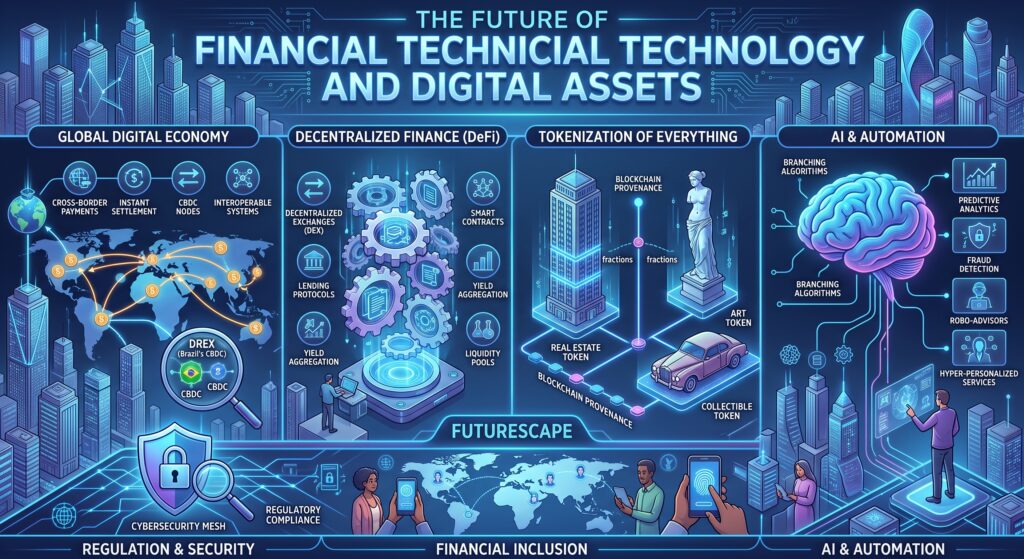
The global financial system is undergoing its most profound structural realignment since the advent of electronic trading. What began as speculative experimentation with decentralized protocols has matured into a foundational layer for cross-border settlement, programmable liquidity, and institutional capital markets.
As regulatory frameworks achieve global standardization and enterprise-grade infrastructure replaces siloed legacy systems, the convergence of Financial Technology (Fintech), Digital Assets, and Artificial Intelligence (AI) is establishing a friction-free, 24/7 financial architecture.
1. Regulatory Clarity as an Accelerator for Institutional Capital
For over a decade, institutional adoption of digital assets was constrained by regulatory ambiguity. Today, definitive policy frameworks across major financial jurisdictions have transformed digital assets from alternative investments into compliant infrastructure.
- Comprehensive Frameworks: Enactments such as the GENIUS Act and CLARITY Act in the United States, alongside the European Union’s Markets in Crypto-Assets (MiCA) regulation, have established clear guardrails for stablecoin reserve backing, token classification, and custodial obligations.
- Institutional Grade Custodial Standards: Tier-one banks and registered investment advisers can now directly manage, lend, and settle digital assets through state-trust structures and regulated custody channels.
- Shift from Reactive Enforcement: Regulators have moved toward proactive, principle-based oversight, giving enterprises the legal certainty required to deploy capital at scale.
This regulatory bridge allows institutional capital—including pension funds, asset managers, and corporate treasuries—to participate in digital asset markets without facing existential legal or compliance risks.
2. Real-World Asset (RWA) Tokenization and Programmable Capital
Tokenization—the process of issuing digital representations of physical or traditional financial assets on distributed ledgers—has emerged as the multi-trillion-dollar engine driving the next phase of capital market efficiency.
Traditional Asset (e.g., T-Bills, Real Estate)
       │
       ▼
Smart Contract Deployment (Compliance & Permissions)
       │
       ▼
On-Chain Tokenized Security (24/7 Liquidity & Fractional Ownership)
The Benefits of On-Chain Assets
- Near-Instant Settlement ($T+0$): Traditional clearing cycles ($T+1$ or $T+2$) tie up billions in collateral. On-chain execution enables atomic, peer-to-peer settlement, reducing counterparty and liquidity risk.
- Fractional Ownership: High-value asset classes—such as commercial real estate, private equity, and infrastructure bonds—can be divided into micro-fractions, broadening access for retail and mid-market institutional investors.
- Automated Compliance: Smart contracts embed KYC/AML rules and investor eligibility checks directly into the token itself, eliminating manual back-office reconciliation.
The tokenization of U.S. Treasury Bills and government bonds has already provided funds and corporate treasuries with yield-bearing, collateral-efficient digital cash equivalents. Major banking institutions are actively expanding this model to tokenized bank deposits and syndicated loans.
3. Stablecoins and Central Bank Digital Currencies (CBDCs)
Stablecoins have evolved from crypto trading collateral into the primary native currency of internet commerce. With annual global transaction volumes rivaling traditional payment networks, fiat-backed digital tokens now serve as a crucial cross-border settlement rail.
| Payment Architecture | Settlement Speed | Operating Hours | Transaction Friction |
| Traditional Correspondent Banking | 1 to 3 Business Days | Mon–Fri (Business Hours) | High (Multiple Intermediaries) |
| Legacy Card Networks | 1 to 3 Days (Merchant Payout) | 24/7 Processing | Medium-High (Interchange Fees) |
| Regulated Stablecoin Rails | Seconds to Minutes | 24/7/365 Continuous | Very Low (Fraction of a Cent) |
Concurrently, wholesale Central Bank Digital Currencies (CBDCs) and regulated deposit tokens are being implemented by central banks and commercial institutions to facilitate interbank liquidity management, instantly reducing cross-border friction.
4. The Intersection of AI and Autonomous On-Chain Commerce
The rapid maturation of Artificial Intelligence is giving rise to a new economic paradigm: machine-to-machine commerce.
Autonomous AI agents—capable of negotiating contracts, purchasing compute power, and managing data workflows—require native, friction-free payment channels. Traditional banking mechanisms (which rely on credit cards and bank accounts tied to human identities) are ill-suited for micro-transactions executed by software.
┌─────────────────┐       On-Chain Micro-Payment       ┌──────────────────┐
│  AI Agent A     │ ─────────────────────────────────► │   AI Agent B     │
│ (Seeks Compute) │ ◄───────────────────────────────── │ (Provides Data)  │
└─────────────────┘      Instant Service Delivery      └──────────────────┘
- Micro-Payment Protocols: Blockchain protocols allow AI agents to execute trustless micro-payments per API call or transaction without human intervention.
- On-Chain Risk & Compliance Auditing: Machine learning algorithms continuously analyze distributed ledgers for real-time wallet risk scoring, automated sanctions screening, and dynamic reserve monitoring.
- Algorithmic Liquidity Management: AI models actively rebalance cross-chain treasuries and automated market maker pools to maximize capital efficiency while minimizing impermanent loss.
5. Security, Risk Mitigation, and Operational Resilience
While the transformation of fintech offers unprecedented efficiency, it introduces novel technical and systemic risks that require rigorous engineering and operational controls:
- Concentration Risk in Custody: A significant portion of institutional crypto assets remains held by a small group of specialized custodians. Diversification across multi-party computation (MPC) solutions and decentralized custody frameworks is vital for operational resilience.
- Smart Contract Vulnerabilities: Autonomous financial code requires continuous formal verification and continuous auditing to prevent catastrophic exploit vectors.
- Data Provenance and Deepfakes: As AI and financial systems merge, verifying input data integrity and human identity becomes essential to prevent algorithmic manipulation and fraud.
Conclusion: Building the Next-Generation Financial Layer
The future of fintech and digital assets is no longer defined by speculative hype, but by structural utility, regulatory integration, and institutional scalability.
As real-world asset tokenization bridges legacy capital markets with decentralized networks, and as stablecoins and AI agents streamline global settlement, the global economy is transitioning toward an open, programmable, and continuously operating financial infrastructure. Institutions that build and adapt around these invisible, regulated digital rails today will define the competitive landscape of global finance tomorrow.
Related